
Archive and memory
The catalogue raisonné goes digital
From Gersaint’s Rembrandt of 1751 to Cézanne online: what changes when the catalogue raisonné leaves paper, in numbering, dating, exclusions and lifespan.
Raisonné is an eighteenth-century word. In 1751 two books carrying it in their titles came out in Paris. On 28 June the first volume of Diderot and d’Alembert’s Encyclopédie appeared, describing itself as a Dictionnaire raisonné des sciences, des arts et des métiers. The same year saw the posthumous printing of the Catalogue raisonné de toutes les pièces qui forment l’œuvre de Rembrandt by the dealer Edme-François Gersaint, devoted to the prints: The Rembrandt Database calls it the first catalogue raisonné dedicated to a single artist. In both titles raisonné means ordered by a method and accompanied by a judgement. A list counts the works. A catalogue raisonné states why each one is there.
I remind myself of this whenever I hear that a digital catalogue raisonné turns into a database. The database is the container. The reasoning is still somebody’s work, and it carries a date.
A judgement that changes
Rembrandt is the clearest example. In 1836 the English dealer John Smith published the first survey of all the paintings: 588 of them, about half of which Smith had seen in person. In 2014 the sixth volume of A Corpus of Rembrandt Paintings, by Ernst van de Wetering, accepted 350 as by Rembrandt, or by Rembrandt with a pupil. Between the two lie almost two centuries of attributions given and withdrawn. Whoever opens a catalogue raisonné is reading a reasoned opinion, and a reasoned opinion can be revised. In a conversation published by We Wealth in 2020, the art historian Sharon Hecker and the lawyer Giuseppe Calabi point out that Modigliani has five catalogues, with two more in preparation.
What Italy’s Supreme Court said
In Italy this nature of judgement has a precise legal consequence. In order no. 3231 of 2025, in a case involving the Fondazione Lucio Fontana, the Court of Cassation held that a private body cannot be ordered to include a work in its own catalogue. As Francesco Machina Grifeo reports in Il Sole 24 Ore’s NT+ Diritto, the Court places an opinion on authenticity under the freedom of expression protected by Article 21 of the Constitution, and calls it a critical judgement that cannot be compelled. Making a court finding known to a buyer is up to the owner of the work. This note summarises one decision and is not a substitute for legal advice.
From paper to screen
The limits of the printed volume were set out by the Getty Foundation, which in 2009 launched the Online Scholarly Catalogue Initiative with eight museums, among them the Art Institute of Chicago, Tate and the National Gallery of Art in Washington. The final report, Museum Catalogues in the Digital Age, dates from 2017. Print runs are small because printing is expensive. The content ages with the first acquisition or the first discovery. The page fixes how much can be shown.
In November 2014 the catalogue of Paul Cézanne’s paintings went online, signed by Walter Feilchenfeldt, Jayne Warman and David Nash. It had begun as a colour reissue of John Rewald’s 1996 catalogue. Writing in Apollo that December, Caroline Rossiter noted that each entry can be read alongside Rewald’s numbers and those of Lionello Venturi’s 1936 catalogue, and recorded Nash’s regret: “I had hoped to have my name on the spine of a book”.
The Wildenstein Plattner Institute speaks of a “digital corpus” and publishes sections of a catalogue as they become ready, as it does for Tom Wesselmann. Its guide says an online catalogue can be ongoing research, “continually updated and never truly finished”. The Robert Rauschenberg Foundation has put the first part of its own online, 122 works dated between 1948 and 1953, and announces the same material in book form for winter 2027. Paper comes back, then, as a photograph of one moment in the research.
Four things that really change
The first is the number. On paper every new catalogue renumbers the works and prints a concordance table at the back. Online the numberings live together in the same entry, as in the Cézanne. On one condition: a number once assigned is never reused, even when the work is excluded.
The second is the date. A volume carries its date on the title page, and it holds for every entry. An online entry needs its own, with a trace of what was corrected and when. Anyone citing it must be able to say which version they read; otherwise correction, which is the advantage of digital, erases the evidence of how the judgement was reached.
The third is exclusion. In a book the absent work is silent, and the reader cannot tell whether it was rejected or simply never examined. An online catalogue can state the status of each item: accepted, under study, declined. It is a delicate editorial choice, which is exactly why it should be written down at the start.
The fourth is lifespan. On 8 November 2018 the Dedalus Foundation devoted an evening to the future of online catalogues raisonnés, with Greg Albers of the Getty and Stephen Bury of the Frick Art Reference Library. Two questions were on the programme: whether these publications will stay readable once the languages they are written in become obsolete, and who should look after them. Gersaint’s volume still opens after two hundred and seventy-five years. For a website that has to be decided in advance.
Where ARTITUDE stops
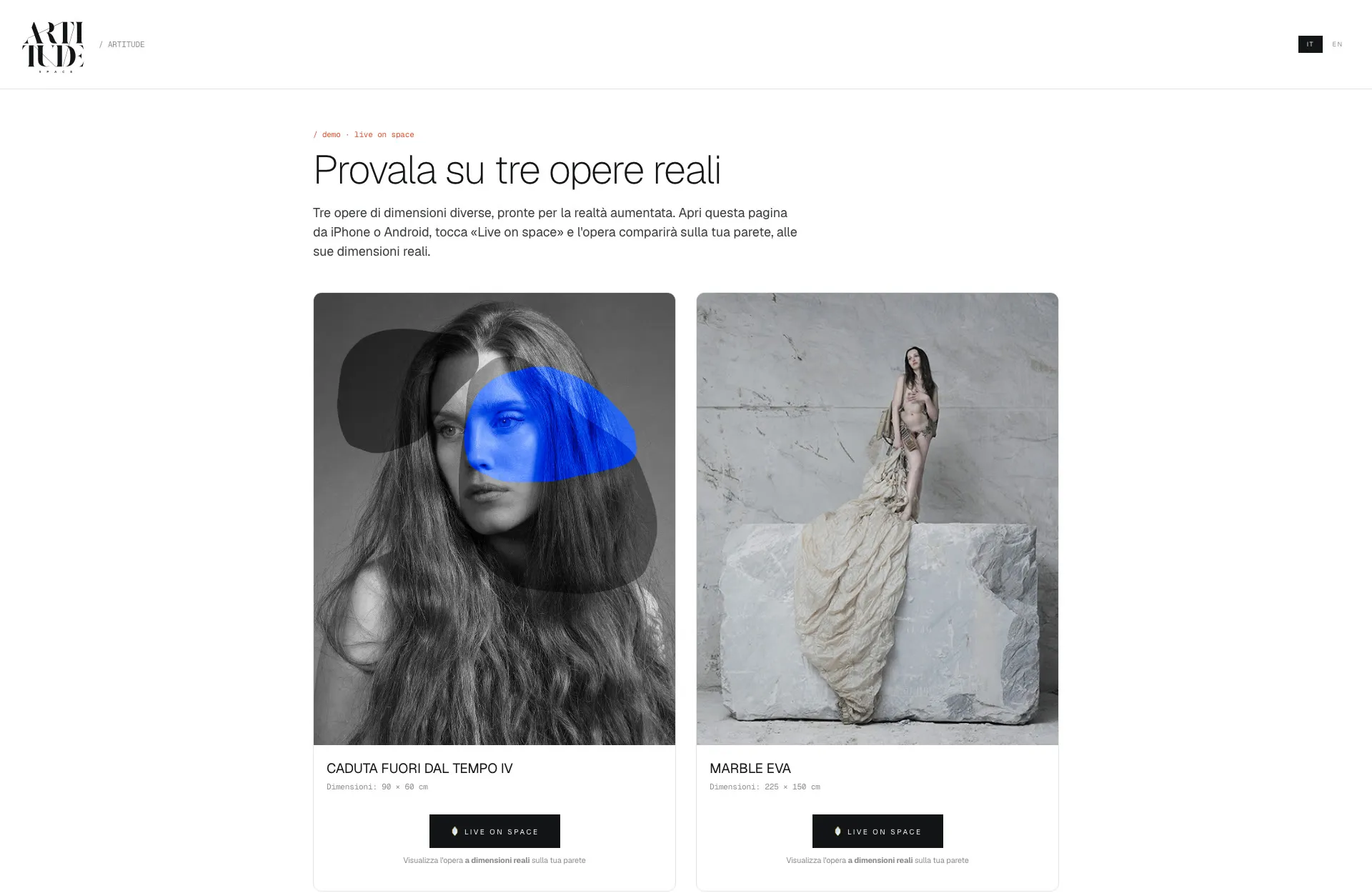
ARTITUDE, the platform the studio conceived and developed, works on the step before. Each work has a record with images, dimensions, techniques, provenance and location; from the record come verifiable digital certificates and exports for catalogues and print. The first archive online is Matteo Basilé’s. The catalogue raisonné comes later and is the work of whoever studies the œuvre and signs their judgement. A well kept archive hands them the data already dated and numbered.
Gersaint died in 1750 and his Rembrandt came out the following year, completed by others. A catalogue raisonné, on paper or online, is made for someone else to continue.
Sources
- The Rembrandt Database, «Oeuvre catalogues» (Gersaint 1751, Smith 1836, van de Wetering 2014) (opens in a new tab)
- ARTFL Encyclopédie Project, University of Chicago, cronologia dell’Encyclopédie (primo volume, 28 giugno 1751) (opens in a new tab)
- S. Hecker, G. Calabi, «Cataloghi ragionati e ragionevoli dubbi», We Wealth, 17 febbraio 2020 (contenuto realizzato con CBM & Partners) (opens in a new tab)
- F. Machina Grifeo, «Fondazioni artistiche, nessun obbligo di inserire nuove opere in catalogo», NT+ Diritto, Il Sole 24 Ore, 12 febbraio 2025 (Cass., ord. n. 3231/2025) (opens in a new tab)
- Getty Foundation, Museum Catalogues in the Digital Age. A Final Report on the Getty Foundation’s Online Scholarly Catalogue Initiative, 2017 (opens in a new tab)
- C. Rossiter, «Cézanne goes digital: catalogue raisonné launches online», Apollo, 22 dicembre 2014 (opens in a new tab)
- Wildenstein Plattner Institute, «What is a Catalogue Raisonné and Why is it Useful?» (opens in a new tab)
- Robert Rauschenberg Foundation, Catalogue Raisonné (opens in a new tab)
- Dedalus Foundation, «Preparing for Tomorrow: The Future of Online Catalogues Raisonnés», 8 novembre 2018 (opens in a new tab)
- ArtistProof, ARTITUDE, scheda del lavoro (opens in a new tab)
Credits
Images: ARTITUDE, platform conceived, designed and developed by ArtistProof, 2026. Works in the augmented reality preview: Matteo Basilé.