Atlas
DOOH explained by screen composers
Digital out-of-home: advertising on the screens of cities, stations and airports. What the acronym means, how big it is, how it is bought and what constraints it sets for those who make the images.

Every night in Times Square, at 11:57 pm, more than ninety screens between 41st and 49th Street stop selling things. For three minutes, until midnight, they all show the same artwork. It is called Midnight Moment, Times Square Arts has run it since 2012 and it changes artist every month; in December 2026 it is Jenny Holzer’s turn. In London, since 1 October 2020, CIRCA has done something similar on the great curved screen at Piccadilly Circus: two minutes a day, from 8:20 pm in that first year, opened by Ai Weiwei. These are the exceptions that reveal the rule. For the rest of the day those screens are DOOH, and working with them means knowing their laws.
A definition
DOOH stands for digital out-of-home. In December 2024 IAB, the US digital advertising association, published a definition: digital media used for marketing, with screens in public and commercial spaces showing dynamic or interactive content. The phrase that sums it up is “Screens, Not Signs”. Content can change with the time of day, the weather or a match result; automated buying, contrary to what one often reads, is not a requirement. Phones, printed signs even with a QR code, in-app ads and television watched in a bar are all excluded.
The OAAA, the American out-of-home association, uses “digital” as an adjective for four existing families: billboards, street furniture, transit and places such as malls, gyms and cinemas. Digital signage is something else: the screens and software that also guide passengers or inform staff. No association has drawn the line formally; the most useful distinction, which is ours, is this: the same screen becomes DOOH when its time is sold to an advertiser.
How big it is
According to the World Out of Home Organization’s 2026 report, global out-of-home spending reached 54.2 billion dollars in 2025, of which 25.5 billion was digital, 47 per cent. For 2026 WOO expects digital to overtake print for the first time, at 49 per cent. PQ Media, using a different method, estimates 12 per cent digital growth in 2025. The two series should not be added up or compared line by line.
In Italy the Internet Media Observatory of the Politecnico di Milano puts DOOH at 273 million euros in 2025, 36 per cent of an out-of-home market worth 766 million. In 2018 it was 102 million; in 2020 the pandemic brought it down to 69. Nielsen, which only tracks the sales houses belonging to Audioutdoor, gives 336 million for all outdoor advertising: different scopes, different numbers.
How it is bought
Screen space is sold in plays within a cycle, the loop. If the loop lasts sixty seconds and holds six spots, each spot gets one sixth of the time. To estimate how many people see it, IAB’s July 2025 guide uses a multiplier: plays times the average number of people in the viewing area, derived from footfall and dwell time. The Media Rating Council finalised its out-of-home measurement standards in December 2025; in the UK the shared currency is called Route.
Automated buying, programmatic, runs through platforms connecting sellers (supply side) and buyers (demand side), with prices per thousand estimated impressions and rules based on time, place and data. Its share is still small: about 1.3 billion dollars in 2025 according to a WOO and PwC study of the platforms, 2.1 billion according to the associations WOO surveyed itself. In Italy Grandi Stazioni Retail launched it in 2023 with Hivestack.
The composer’s constraints
For those who make the images, DOOH is a repertoire of formats unlike any other. JCDecaux’s public UK specifications give an idea: a vertical roadside screen of 1080 by 1920 pixels takes only 12-second still images; in airports it becomes 10 seconds of video at 25 frames per second; at Waterloo station a 6720 by 480 pixel strip takes only 20-second video. Sound is almost always absent.
On the road, rules decide. In the UK the Outsmart industry code bans video and animation on roadside screens without specific consent, requires at least 5 seconds between images with a transition of no more than one second, and caps night-time brightness. In Italy the implementing regulation of the Highway Code (Presidential Decree 495/1992), outside built-up areas, bans flashing light and luminance above 150 candelas per square metre (Article 50) and, for variable messages set across the flow of traffic, changes more frequent than every five minutes (Article 51); within built-up areas municipal rules apply. Before drawing a single frame it pays to know whether it will be allowed to move.

What we ask before starting
At Fiumicino the check-in wall is about 130 metres long and the file for Voci dal futuro measures 1920 by 270 pixels: no standard grid would have predicted it. So the first thing we ask a media owner for is the technical sheet, with the size in pixels, the length of each play, the length of the loop, whether motion is allowed and whether there is sound. Then we want to know where the screen sits in relation to the viewer, whether people meet it walking, queuing or from a car. A spot in a loop is almost always seen halfway through, by someone passing: it has to hold up when met in the middle.
Midnight Moment works because for three minutes the loop stops and every screen says the same thing. The rest of the night is DOOH, and in that time sold by the second there is still room for an image worth looking at.
Sources
- Times Square Arts, Midnight Moment (opens in a new tab)
- CIRCA, comunicato stampa, Ai Weiwei su Piccadilly Lights, 1 ottobre 2020 (opens in a new tab)
- IAB, «Digital Out-of-Home (DOOH): Definition and Core Features», dicembre 2024 (opens in a new tab)
- OAAA, Standard OOH Business Practices (opens in a new tab)
- World Out of Home Organization, Global Out of Home Expenditure Report 2026 (opens in a new tab)
- PQ Media, Global Digital Out-of-Home Media Forecast 2026-2030, comunicato, 5 agosto 2026 (opens in a new tab)
- Osservatorio Internet Media, Politecnico di Milano, convegno del 31 marzo 2026, dati a consuntivo (opens in a new tab)
- Nielsen, stima del mercato pubblicitario gennaio-dicembre 2025, Touchpoint, febbraio 2026 (opens in a new tab)
- IAB, DOOH Measurement Guide, luglio 2025 (opens in a new tab)
- Media Rating Council, Out-of-Home Measurement Standards, Phase 1 & 2 Combined, dicembre 2025 (opens in a new tab)
- World Out of Home Organization e PwC, Global pDOOH Spend Study 2025 (opens in a new tab)
- «Grandi Stazioni Retail e Hivestack annunciano la loro partnership nel mercato del programmatic DOOH in Italia», ExchangeWire, 6 febbraio 2023 (opens in a new tab)
- JCDecaux UK, Digital Technical Specifications (opens in a new tab)
- Outsmart, Large Format Digital Roadside Planning Code (opens in a new tab)
- DPR 16 dicembre 1992, n. 495, Regolamento del Codice della strada, artt. 50 e 51 (opens in a new tab)
- ArtistProof, Voci dal futuro, scheda del lavoro (opens in a new tab)
Credits
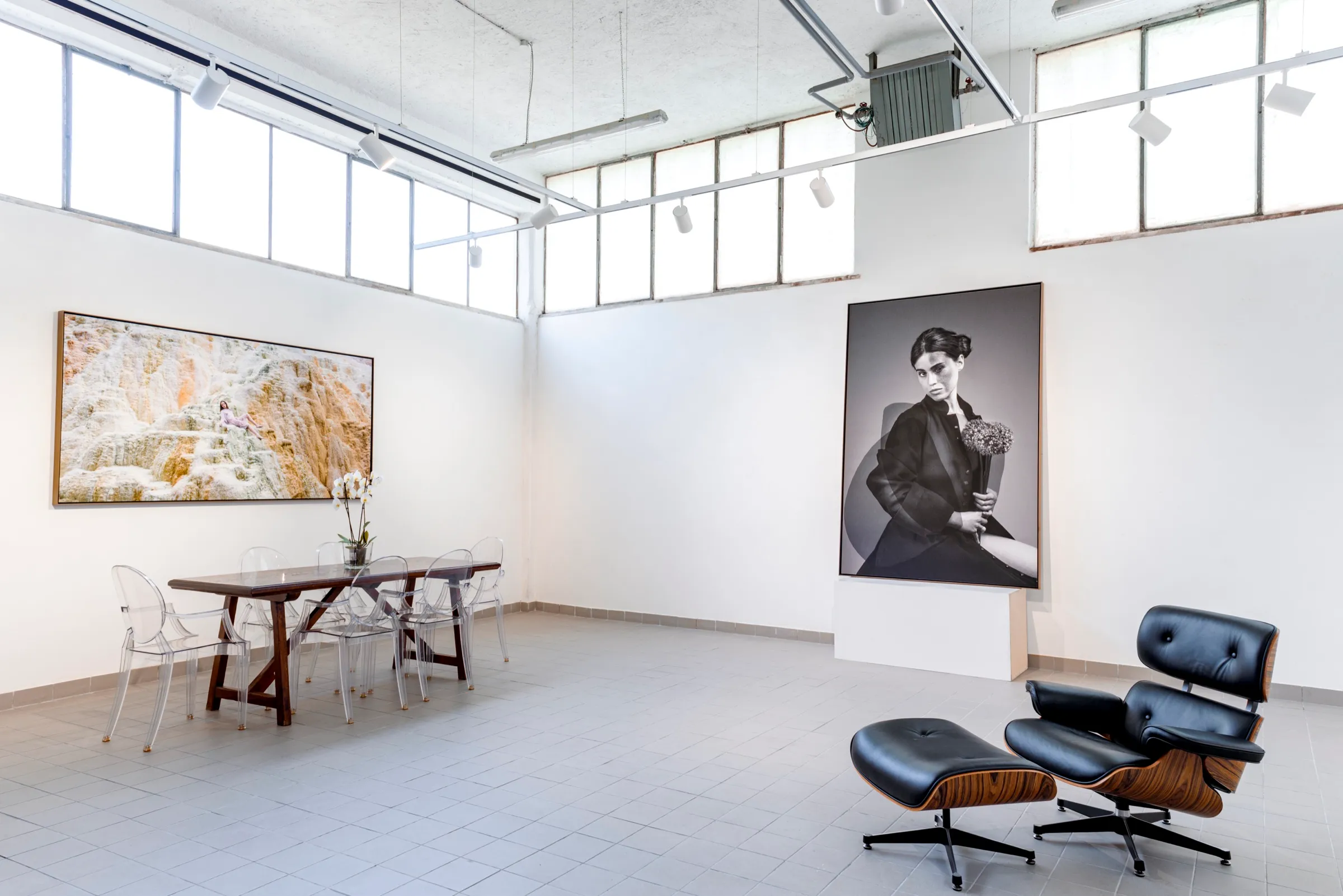
Images: Voci dal futuro, video work by Matteo Basilé produced by ArtistProof for the LED wall of Fiumicino Terminal 1, from the photographs of the TIM campaign with Victoria De Angelis.