Atlas
Anamorphic video on the street
From the skull in Holbein’s Ambassadors to the giant cat of Shinjuku: why an anamorphic image reads from a single spot, and what that means for anyone designing a screen in the city.
In the church of Sant’Ignazio in Rome, halfway down the nave, a disc of yellow marble is set into the floor. Stand on it and look up and you see a dome. Take a few steps towards the altar and the dome starts to bend, because there is no dome: it is a canvas painted by Andrea Pozzo in 1685, in place of the one the Jesuits could not afford to build. The disc, originally bronze, is the most honest part of the work. It tells visitors where to stand for the trick to succeed. The canvas went through damage and restoration in the nineteenth and twentieth centuries, and sources disagree on how much of the original survives; the principle has stayed intact.
I think of it every time a brief asks for “a 3D effect” on a street screen. My first question is where the disc is.
A shape that comes back together
Anamorphosis comes from Greek: ana, back or again, and morphē, shape. It is a distorted figure that recovers its form only from one precise spot. The most famous case is in London, at the National Gallery: in The Ambassadors, painted by Hans Holbein the Younger in 1533, an elongated smear floats at the two men’s feet and turns into a skull only for those who look at the picture from below, on the right. The museum’s own page is exact about it: the skull can only be seen properly by looking “from the bottom right corner”.
In the seventeenth century distortion became a science. In 1638 the Minim friar Jean-François Niceron published La Perspective curieuse in Paris, a manual for building images that read from one angle or reflected in a curved mirror. The Minims also had a convent in Rome, where Emmanuel Maignan painted an anamorphic Saint Francis of Paola that still survives. Fifty years later Pozzo set out his own method in Perspectiva pictorum et architectorum, published in Rome in 1693. Anyone designing an anamorphic billboard today is redoing, with software, the calculations in those treatises.
The corner screen
The contemporary version was born on the LED façades of East Asia. In May 2020 in Seoul, the Korean studio d’strict aired WAVE on the curved façade of the SMTown COEX Artium on K-Pop Square in Gangnam, a screen of about 80 by 20 metres: a wave seems to crash inside a glass tank hanging over the street. In July 2021 in Tokyo, a giant calico cat leaned out of the curved 4K screen of Cross Shinjuku Vision, three storeys tall, opposite the east exit of Shinjuku station. The following year the media arts festival of Japan’s Agency for Cultural Affairs gave it an award in the entertainment division. In March 2022, on the same screen, Nike opened its orange shoebox towards passers-by for Air Max Day, with creative direction by Kota Iguchi for the CEKAI collective; at the end the cat’s paw appears, the screen’s resident.
In all three cases the screen folds around a corner. That is what makes the illusion possible: two planes meeting give the designer a real edge, on which to line up the edge of a painted box. Daktronics, an LED screen maker, names outside corners and curved surfaces as the ideal positions, and warns that the result takes a great deal of work and money.
The viewpoint is the contract
Dave Haynes, who has followed the industry for years through Sixteen:Nine, now hosted by invidis, pointed out in 2022 something anyone producing this content knows well: almost every promotional video is shot from the spot where the screen’s corner sits at ninety degrees. Face it head on or from the side and the effect is gone. And so-called naked-eye 3D, he added, does not depend on the screen, which does nothing special: “It’s all in the creative”.
On the technical side the only published rules come from manufacturers. One of the most quoted says the minimum viewing distance in metres roughly equals the pixel pitch in millimetres. No independent standard exists. What matters in the project is knowing where people stop: a metro exit, a crossing with a red light, a bench. In Shinjuku, Pozzo’s disc is the square in front of the east exit.
Who is really watching
There is also a suspicion worth stating. The illusion works best in the vertical video shot from the right spot and shared. Industry studies, such as the one by BCN Visuals reported by MediaPost, claim that more than half of the audience would film and share an anamorphic ad; but they come from people who sell these ads. I have not found independent research comparing live viewing with viewing on a phone. Clear Channel UK, which runs outdoor screens, argues that 3D should not be reduced to anamorphic tricks and points to systems that adapt the perspective to people on the move.
On the road there is a safety question too. A Swedish study published in 2013 in Traffic Injury Prevention, with 41 drivers in Stockholm, found that electronic billboards draw more frequent and longer glances than road signs, without concluding that they are dangerous; other research reaches different results. Studies specific to anamorphic screens do not exist yet.
What we take from Fiumicino
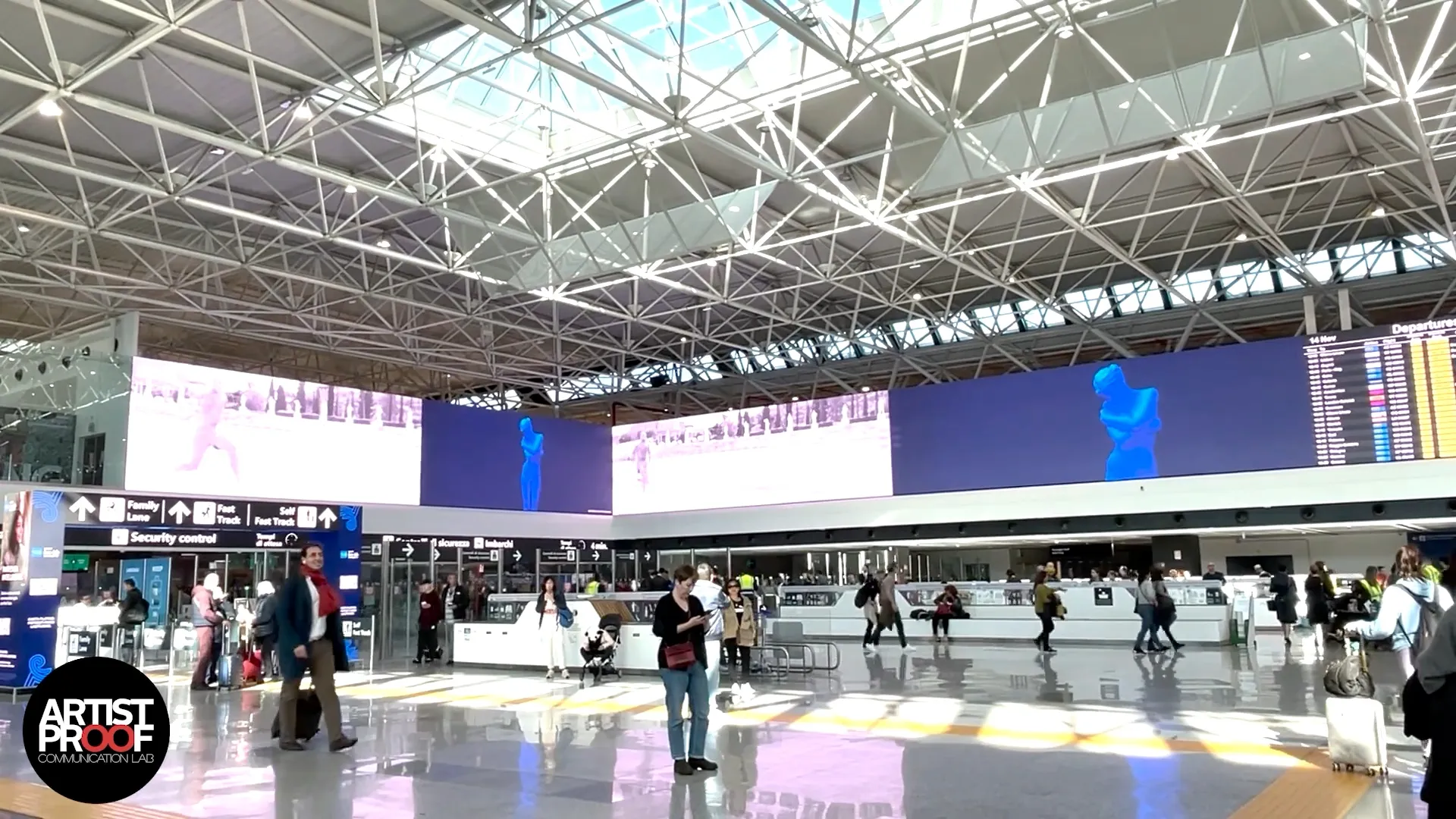
The check-in LED wall in Fiumicino Terminal 1, where the studio brought Jacobs in 2022 and Voci dal futuro, is about 130 metres long and turns a corner. It has the right edge for an illusion. What it lacks is the disc: in a terminal people walk towards security with their luggage, and there is no spot where they stop to look. An anamorphosis would read for three steps and be wrong for all the others. That is why our videos for that wall are composed for a moving gaze, with figures that multiply along the surface.
The anamorphic effect works on the street when the place already has a spot where people stop. Where there is none, it is better to compose for those passing by. Pozzo knew it, and he set the disc into the floor.
Sources
- F. Giannini, I. Baratta, «Il capolavoro di Andrea Pozzo: la Gloria di Sant’Ignazio a Roma», Finestre sull’Arte, 14 novembre 2024 (opens in a new tab)
- National Gallery, Londra, Hans Holbein il Giovane, The Ambassadors, 1533, NG1314 (opens in a new tab)
- W. B. Ashworth Jr., «Scientist of the Day: Jean-François Niceron», Linda Hall Library, 22 settembre 2016 (opens in a new tab)
- «d’strict’s “WAVE” anamorphic illusion in Seoul», Hypebeast, 18 maggio 2020 (opens in a new tab)
- «A super-realistic giant 3D cat has appeared on a billboard in Shinjuku», Time Out Tokyo, 6 luglio 2021 (opens in a new tab)
- Agenzia per gli affari culturali del Giappone, 25° Japan Media Arts Festival, Social Impact Award, GIANT 3D CAT (opens in a new tab)
- «Ad of the Day: Nike debuts 3D billboard in Shinjuku in run-up to Air Max Day», The Drum, 22 marzo 2022 (opens in a new tab)
- Daktronics, «3D Content is Coming on Strong» (opens in a new tab)
- D. Haynes, «Enough With The Naked Eye 3D LED Stuff, Please!», invidis, 23 giugno 2022 (opens in a new tab)
- «Are 3D Anamorphic Billboards The Future? Q&A With BCN Visuals’ Lina Maggi», MediaPost (opens in a new tab)
- Clear Channel UK, «The new dimension in OOH» (opens in a new tab)
- T. Dukic et al., «Effects of electronic billboards on driver distraction», Traffic Injury Prevention, 14(5), 2013, pp. 469-476, PubMed (opens in a new tab)
- ArtistProof, Jacobs, scheda del lavoro (opens in a new tab)
Credits
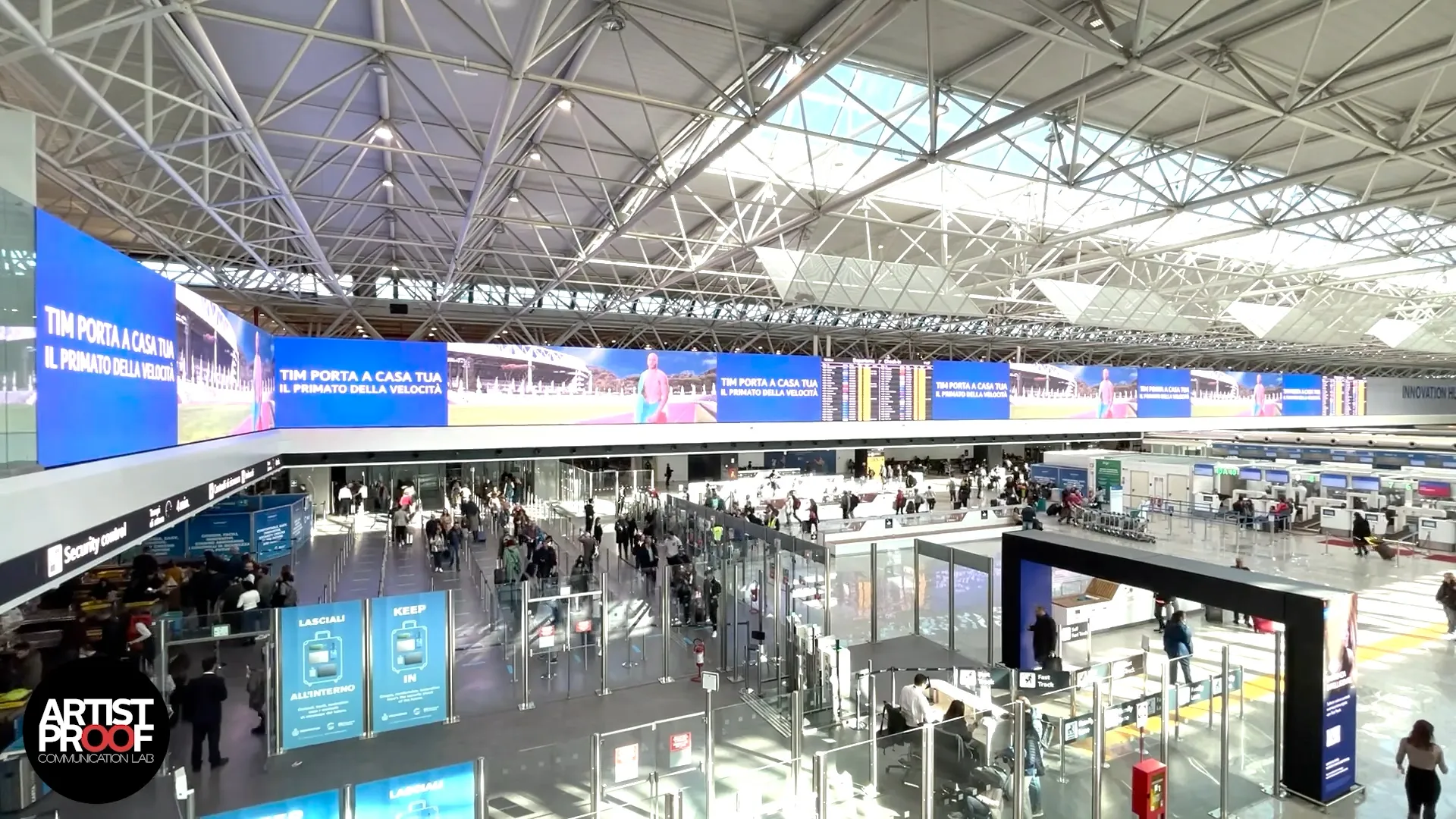
Images: Jacobs, video installation by ArtistProof from a photograph by Matteo Basilé, TIM Fibra 10 Giga campaign, Fiumicino Terminal 1, 2022.