Archive and memory
How to set up an artist archive
From inventory number to catalogue raisonné: how to organise a living artist’s archive, with the standards and rules to know and the ARTITUDE method.
Archive comes from the Greek arkheion, the house of the archons, the Athenian magistrates who kept the documents on which the law depended. In 1995 Jacques Derrida opened Mal d’archive (Archive Fever in English) with this word and its root, arkhē, which holds two meanings at once: beginning and command. I think of it every time I walk into a living artist’s studio. Folders of negatives, foundry invoices, catalogues with dedications, files scattered across three different drives: the beginning is all there already. What is missing is the command, an order that lets someone else, tomorrow, know what was made, when, with which materials and where it is now.
Who does this work in Italy
In Italy an artist archive is almost always a private body: a foundation, an association, often the family. Since 2023 there has been a reference manual, L’archivio d’artista. Principi, regole e buone pratiche (Johan & Levi), edited by Alessandra Donati, who teaches comparative law and art law at the University of Milano-Bicocca, and Filippo Tibertelli de Pisis, founder and president of AitArt, the Italian Association of Artist Archives. As the University of Pisa noted when presenting the book, it grew out of the association’s course for archive curators and covers how an archive is structured, the legal rules and customs, inheritance, and the catalogue raisonné. On its website AitArt describes archives as cultural bodies that order, preserve and make known an artist’s life and work.
It starts with counting
The first step is the humblest. One inventory number per work, assigned once and never reused, even when the work is sold, destroyed or remade. In 2022 the Joan Mitchell Foundation in New York, through its Creating a Living Legacy programme, published Career Documentation for the Visual Artist, a free guide edited by Shervone Neckles-Ortiz and Kay Takeda with contributions from sixteen professionals. Its chapters follow the practical order of the work: priorities and goals, the people who help, budgeting for an inventory kept over time, the artwork inventory, digital images, the bibliography, a preservation plan, a career timeline. It is written for living artists, which is what makes it useful: an archive should be started while its author can still answer questions.
What goes into a record
For the minimum fields it pays to start from a standard born of a concrete problem, theft. Object ID was launched in 1993 by the Getty Information Institute together with police forces, customs agencies, museums, the art trade, appraisers and insurers, and was presented in 1997; today ICOM promotes it. It defines nine categories: type of object, materials and techniques, measurements, inscriptions and markings, distinguishing features, title, subject, date or period, maker. The instructions come in four steps: photograph the work, answer the nine categories, add a short description, keep the documentation somewhere safe.
Anyone cataloguing a contemporary work soon sees what is left out. Provenance, meaning the chain of ownership. Exhibitions and bibliography. For photographs and multiples, the edition and print run, with the number of each copy. For video or interactive works, the files, the devices and the installation instructions, which age faster than paper.
Provenance also carries legal weight
Article 64 of Italy’s Code of Cultural Heritage and Landscape (Legislative Decree 42/2004) requires anyone who sells, offers for sale or brokers the sale of paintings, sculptures, prints and antiques to give the buyer documents attesting authenticity, or at least probable attribution and provenance. Where those documents are missing, a declaration with all the information available is required, attached where possible to a photograph of the work. With an orderly archive the answer takes a few minutes; without one, the question passes to an heir, a gallerist, an appraiser. This note describes the rule and is not a substitute for legal advice.
The catalogue raisonné on the horizon
The traditional goal of an archive is the catalogue raisonné, the complete annotated list of an artist’s works. In the United States the Catalogue Raisonné Scholars Association has brought together the people who compile them since 1994. In July 2019, at the Royal Academy in London, the International Catalogue Raisonné Association was founded on that model: as Margaret Carrigan wrote in The Art Newspaper, it sets out to establish best practice and to support the authentication of works in a market exposed to fakes. A catalogue raisonné takes years. A well kept archive prepares its material every day, one record at a time.
The ARTITUDE method
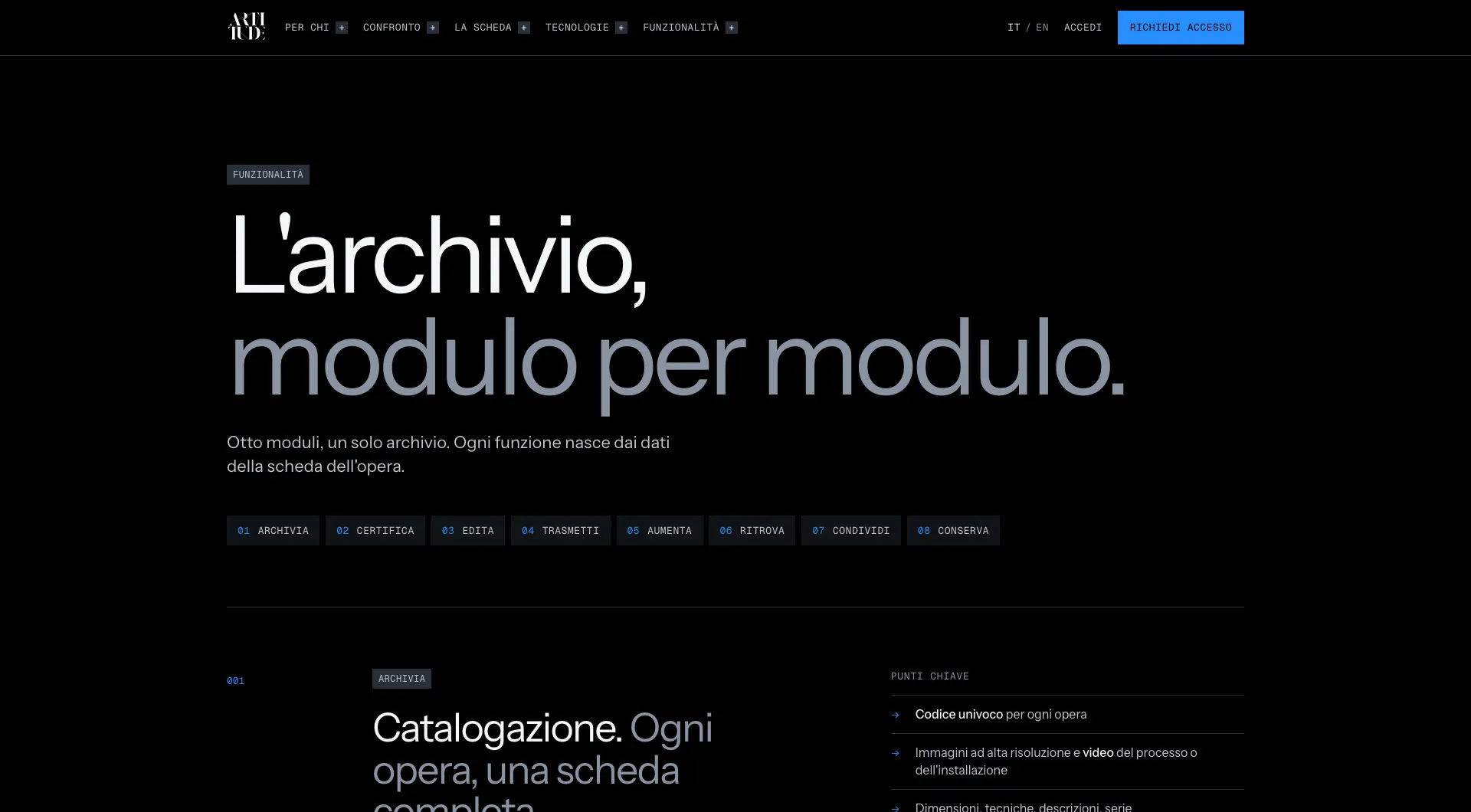
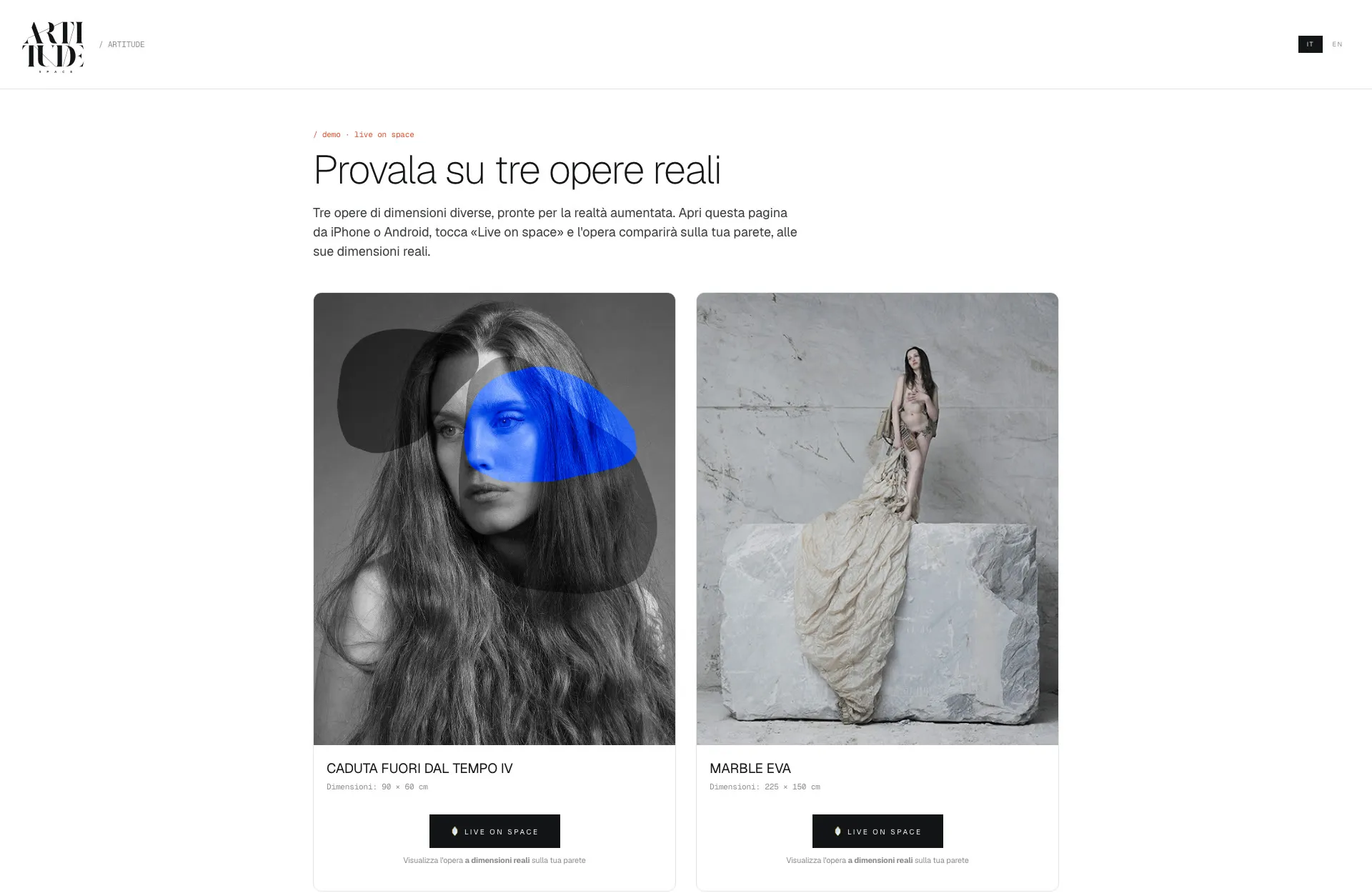
ARTITUDE is the platform the studio conceived, designed and developed for artist archives, collections, foundations and museums. Each work has a record with images, dimensions, techniques, provenance and location; from the record come verifiable digital certificates, augmented reality content and exports for catalogues and print. Our part ends at a precise point: we set up the archive structure, work alongside the initial import and train the people who will run it. From then on the archive belongs to those who keep it. The first archive online is Matteo Basilé’s.
For anyone starting now
The order I suggest is simple. Decide who has the final word on the data, the artist or a curator, and write it down. Assign inventory numbers before photographing. Fill in the nine Object ID categories for every work, even incomplete, marking what is missing instead of guessing it. Keep provenance documents inside the work’s record, not in a separate folder. Store copies in two different places.
The archons kept documents because the law of the city depended on them. An artist’s archive keeps something more fragile: the chance that a work will be recognised even when the person who made it can no longer say so.
Sources
- J. Derrida, Mal d’archive. Une impression freudienne, Galilée, 1995 (trad. ingl. Archive Fever, E. Prenowitz, University of Chicago Press, 1996) (opens in a new tab)
- Università di Pisa, presentazione di A. Donati, F. Tibertelli de Pisis (a cura di), L’archivio d’artista. Principi, regole e buone pratiche, Johan & Levi, 2023 (opens in a new tab)
- AitArt, Associazione Italiana Archivi d’Artista (opens in a new tab)
- Joan Mitchell Foundation, Career Documentation for the Visual Artist, a cura di S. Neckles-Ortiz e K. Takeda, 2022 (opens in a new tab)
- ICOM, Object ID (opens in a new tab)
- D.Lgs. 22 gennaio 2004, n. 42, Codice dei beni culturali e del paesaggio, art. 64, Normattiva (opens in a new tab)
- M. Carrigan, «A new catalogue raisonné organisation aims to foil fakes in the art market», The Art Newspaper, 2 luglio 2019 (opens in a new tab)
- ArtistProof, ARTITUDE, scheda del lavoro (opens in a new tab)
Credits
Images: ARTITUDE, platform conceived, designed and developed by ArtistProof, 2026. Works in the augmented reality preview: Matteo Basilé.