
Rules of the image
AI Act Article 50 for image makers
Since 2 August 2026 the AI Act requires deepfakes to be disclosed. What the European guidelines tell those who make images, campaigns and films.
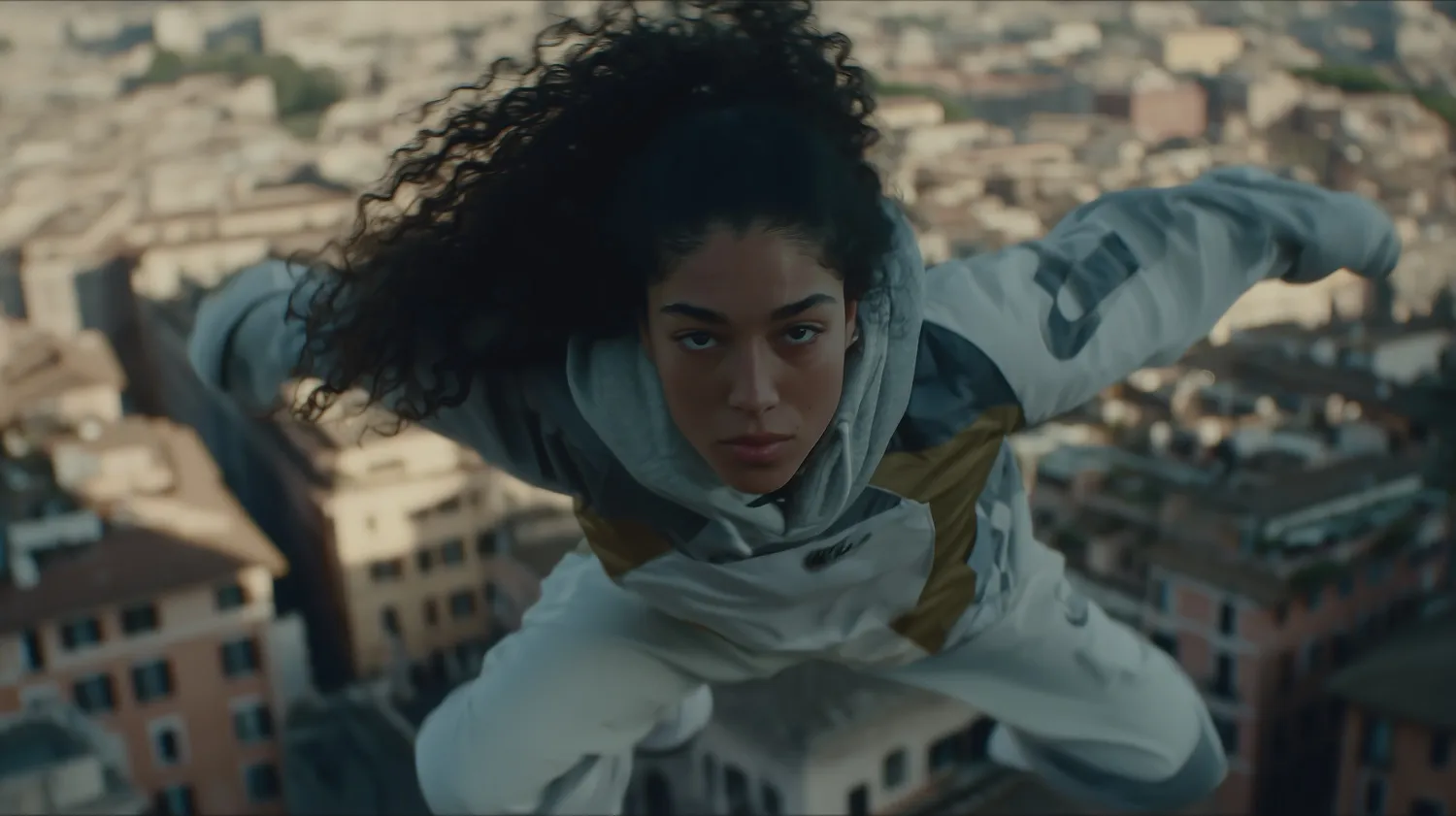
A woman in a grey tracksuit flies over the rooftops of Rome, her eyes fixed on the camera. It is a frame from Rome, the research film the studio produced in 2025 with Matteo Basilé’s AI prompting. Since 2 August 2026, faced with an image like this circulating in the European Union, the first question to ask is a legal one: is it a deepfake? According to the guidelines the European Commission adopted on 20 July 2026, the answer is no, and the reason helps to read the whole rule.
What Article 50 requires
Regulation (EU) 2024/1689, the AI Act, devotes Article 50 to transparency and applies it from 2 August 2026 (Article 113). For people working with images two paragraphs matter. Paragraph 2 concerns providers, those who develop a generative system and place it on the market under their own name: outputs must be marked in a machine-readable format and be detectable as generated or manipulated. Paragraph 4 concerns deployers, those who use such systems under their own authority for professional purposes: if the image, video or audio is a deepfake, it must be disclosed. Paragraph 5 sets the manner, clear and distinguishable, and the moment, at the latest at first exposure.
A studio working with a third-party generator is, as a rule, a deployer. According to the guidelines (point 14), a client who orders an advertisement from an agency, without deciding whether and how AI is used, is not a deployer. The guide to labelling in digital marketing published in September 2026 by IAB Austria with the law firm act legal reaches the same conclusion: the duty normally falls on the agency that produces the work.
What counts as a deepfake
Article 3, point 60, defines a deepfake as generated or manipulated content that resembles existing persons, objects, places, entities or events and would falsely appear authentic or truthful. The guidelines (point 113) read resemblance broadly: it is enough for the subject to exist, to be able to exist, or to have plausibly existed. Then they draw a line every image maker should know. Whatever defies the laws of nature or physics, such as humans flying without mechanical aids, dragons, or elephants driving cars, is treated as unrealistic and falls outside the obligation, provided it has no potential to mislead. The woman flying over Rome is on this side of the line.
Point 116 takes on advertising with concrete examples. A real car shown against a generated background is not a deepfake, as long as the ad does not mislead about how the product looks and is used; an image that makes a product look better than it is, is one. Two mice arguing about cheese in a commercial for a dairy stay outside; a generated video of a celebrity influencer in a promotional setting falls inside.

The prototype the studio developed around Audi’s imagery for Milano Cortina 2026 places a car in a glacial landscape in front of Milan Cathedral. Under point 116 the question to ask concerns the product: if the car is shown as it is, the impossible setting belongs to the aesthetic choices. That is our reading, and each case has to be assessed on its own.
The exception for artistic works
Paragraph 4 provides a lighter regime for deepfakes that form part of evidently artistic, creative, satirical or fictional works or programmes. The obligation remains: disclosure must be made in an appropriate way that does not hamper the display or enjoyment of the work (point 123). Everything rests on the adverb. Point 122 asks for the categories to be read strictly and lists what to weigh: the formats and styles typical of the genre, the context in which the content is presented, and what the audience expects.
On advertising the text is careful. An advertisement or a documentary may count as a creative work in certain specific situations and not in others; where content is both informative and creative, the informative character prevails and the ordinary label applies. Among the examples excluded from the lighter regime is a teleshopping-style video in which synthetic people use a product to persuade viewers to buy it.
In the draft of 8 May 2026, as Philipp Müller-Peltzer of the German firm SRD Rechtsanwälte notes in his commentary, advertising left the lighter regime when commercial purposes prevail. The final text of 20 July leaves the door ajar and refers the matter to case-by-case assessment.

Extraordinary People, the prototype the studio proposed to the City of Rome for Estate Romana 2025, shows a crowd in swimwear around a pool with a large pink inflatable, in front of the Colosseum. The people are realistic and the scene is unlikely without being physically impossible. In our view, with point 122 in hand, a poster like this should carry the ordinary label, because its promotional nature is as evident as its creative one.
When and how to disclose
Point 117 rules out the deployer relying on the invisible marking embedded by the provider: disclosure must be perceivable by a person without technical tools. Point 143 explains that the information applies to every output and every person exposed to it; if some viewers are likely to miss the start of a video, the opening notice should be repeated later on. Point 68, by contrast, excludes from the paragraph 2 marking those outputs that stay inside closed production workflows, naming film, animation, games and advertising: it is the final result that has to be marked.
For the label itself the Commission offers official icons in three versions, including one for fully generated content and one for partly modified content. Using them is optional; the duty to disclose is not. The Code of Practice on marking and labelling AI-generated content, published on 10 June 2026, is voluntary and has one section for providers and one for deployers.
The dates
Regulation (EU) 2026/1744, the Digital Omnibus on AI, published in the Official Journal on 24 July 2026 and in force since 27 July, left Article 50 where it was. It added a single transition: providers of systems already on the market before 2 August 2026 have until 2 December 2026 to apply the paragraph 2 marking. Deployers’ obligations have applied since 2 August. According to the Commission’s FAQ, content created before that date need not be labelled retroactively; the IAB Austria guide adds that the duty returns when content is published again. Fines reach up to 15 million euros or 3 per cent of worldwide annual turnover (Article 99). In Italian, Lorenzo Quadrini set out the framework in Agenda Digitale (September 2026).
The rule separates two things that everyday work tends to blur: what the machine produces and what a person decides to show, to whom and in what setting. The provider’s marking describes the technical origin of a file. The deployer’s disclosure is an act of responsibility towards the viewer, and it stays with whoever signs the campaign or the film. That is why, in its project pages, the studio states the starting material and the stages where AI came in.
This article describes the regulation and the European guidelines; it does not replace legal advice on an individual case.
Sources
- Regolamento (UE) 2024/1689 (AI Act), artt. 3, punto 60, 50, 99 e 113 (opens in a new tab)
- Commissione europea, Guidelines on the implementation of the transparency obligations for certain AI systems under Article 50 of the AI Act, C(2026) 5054 final, 20 luglio 2026 (opens in a new tab)
- Commissione europea, «Commission publishes Code of Practice on marking and labelling AI-generated content», 10 giugno 2026 (opens in a new tab)
- Commissione europea, Code of Practice on AI-generated content, cronologia dei lavori (opens in a new tab)
- Commissione europea, Transparency obligations under Article 50 of the AI Act (FAQ), aggiornate al 24 luglio 2026 (opens in a new tab)
- Commissione europea, EU Icons for labelling AI-generated content (opens in a new tab)
- Regolamento (UE) 2026/1744 (Omnibus digitale sull’AI), GU L del 24 luglio 2026 (opens in a new tab)
- NicFab Blog, «Digital Omnibus on AI: Regulation (EU) 2026/1744 Is Published in the Official Journal», 24 luglio 2026 (opens in a new tab)
- P. Müller-Peltzer, «Deepfake labelling under the AI Act: what the new EU guidance clarifies», SRD Rechtsanwälte, 1 luglio 2026 (opens in a new tab)
- IAB Austria e act legal, «KI-Kennzeichnung im Digitalmarketing», settembre 2026, riassunta da L. Rijo, PPC Land, 27 settembre 2026 (opens in a new tab)
- L. Quadrini, articolo sulle linee guida C(2026) 5054 e sull’articolo 50, Agenda Digitale, 15 settembre 2026 (opens in a new tab)
Credits
Opening image: Rome, research film by ArtistProof, concept, screenplay and AI prompting by Matteo Basilé, 2025. In the text: Audi, Milano Cortina 2026 and Extraordinary People, Estate Romana 2025, campaign prototypes developed independently by ArtistProof (Impossible campaigns), images made with artificial intelligence.