
Atlas
What electrodes on a plant measure
Two electrodes on a leaf record a difference in potential. What that signal holds, from Darwin to plants that make music, and on to Superstes.

The word electrode was put into circulation by Michael Faraday in 1834. The Treccani dictionary recalls how it is built, electro- plus -ode, from the Greek hodos, the way: an electrode is the point where current enters a material or leaves it. I start here because in installations with plants the electrode is often presented as a microphone, an instrument that listens. The etymology offers a more exact image, that of a door. And what passes through a door depends on both of the rooms it connects.
A telegram to Darwin
The most quoted measurement of the nineteenth century comes from a carnivorous plant. In the summer of 1873 Charles Darwin, who was studying insectivorous plants in those years, asked the physiologist John Burdon Sanderson to check whether the leaves of Dionaea, the Venus flytrap, showed an electrical change when stimulated. On 12 September Sanderson noted in his diary that he had worked on the electrical phenomena of Dionaea and telegraphed the results to Darwin. The next day Darwin replied from Down, in Kent, that the result seemed remarkable to him, and suggested he try Drosera next. The letters are transcribed and annotated by the Darwin Correspondence Project at the University of Cambridge.
The instrument was a galvanometer, the same kind of device Emil du Bois-Reymond used to measure impulses in animal nerves and muscles. The plant was being questioned with the tools of animal physiology, and it answered. Ever since, whenever a leaf draws a curve on a trace, we are tempted to read it the way we read an electrocardiogram.

What actually comes through the door
A century and a half later, plant physiology tells several kinds of signal apart. A review published in 2017 in Frontiers in Physiology by Magdalena Szechyńska-Hebda, Maria Lewandowska and Stanisław Karpiński sorts them out. The action potential is an all-or-nothing response of 10 to 80 millivolts, which can be set off by a change in light, by cold or by a mechanical stimulus; it travels through tissue at a few millimetres per second and, in woody plants, up to 400. The variation potential follows wounds, heat and burning: it is slower, between half a millimetre and five per second, and its size depends on how severe the damage is. Then there are local potentials, which stay where they start, and system potentials, which spread after an injury.
The same review holds a detail that ought to be written next to every installation. An electrode resting on the surface of a leaf picks up a mixture of signals, coming from the guard cells of the stomata, from the epidermis and from the mesophyll; and the curve recorded at the surface appears reversed compared with the one measured inside a cell. Whoever places two electrodes on a frond records a choir, and records it upside down.
The Backster effect
In the 1960s the question left the laboratory. In 1966 Cleve Backster, a polygraph expert who had worked for the CIA, attached a galvanometer to a dracaena leaf in his office and reported a surge in the trace at the moment he imagined setting it on fire. In 1973 The Secret Life of Plants, by Peter Tompkins and Christopher Bird, made the story famous. Writing in The New Yorker in 2013, Michael Pollan recalls that several plant scientists tried to reproduce the Backster effect and failed.
The commercial devices that make plants play music today measure something more modest. PlantWave, by Data Garden, describes itself this way: two sensors on the leaves detect slight variations in the plant’s electrical resistance, the signal is drawn as a wave and translated into pitch, which plays instruments prepared by a team of sound designers. Measuring resistance means sending a tiny current between two points and seeing how hard it is for it to cross the tissue, which depends on the state of the leaf as much as on the contact of the electrodes. That is a real fact about the plant. The scale, the timbre and the instruments were chosen by whoever wrote the software.
An orchestra in an arboretum
The clearest statement I have read this year comes from Slovenia. At the Volčji Potok Arboretum the Floral Orchestra, Cvetlični orkester, turns the bioelectrical activity of plants into soundscapes through sensors, electronics and modular synthesizers; a permanent sound installation remains beside a black alder. Slovenia’s official portal, slovenia.si, reported on it in July 2026. Miha Godec, a multimedia artist among the project’s authors alongside creative director Miha Kačič, explains that the signals are not heard directly: technology translates them into sound, and what visitors hear is not the voice of a plant. Whoever translates, in other words, signs the translation.
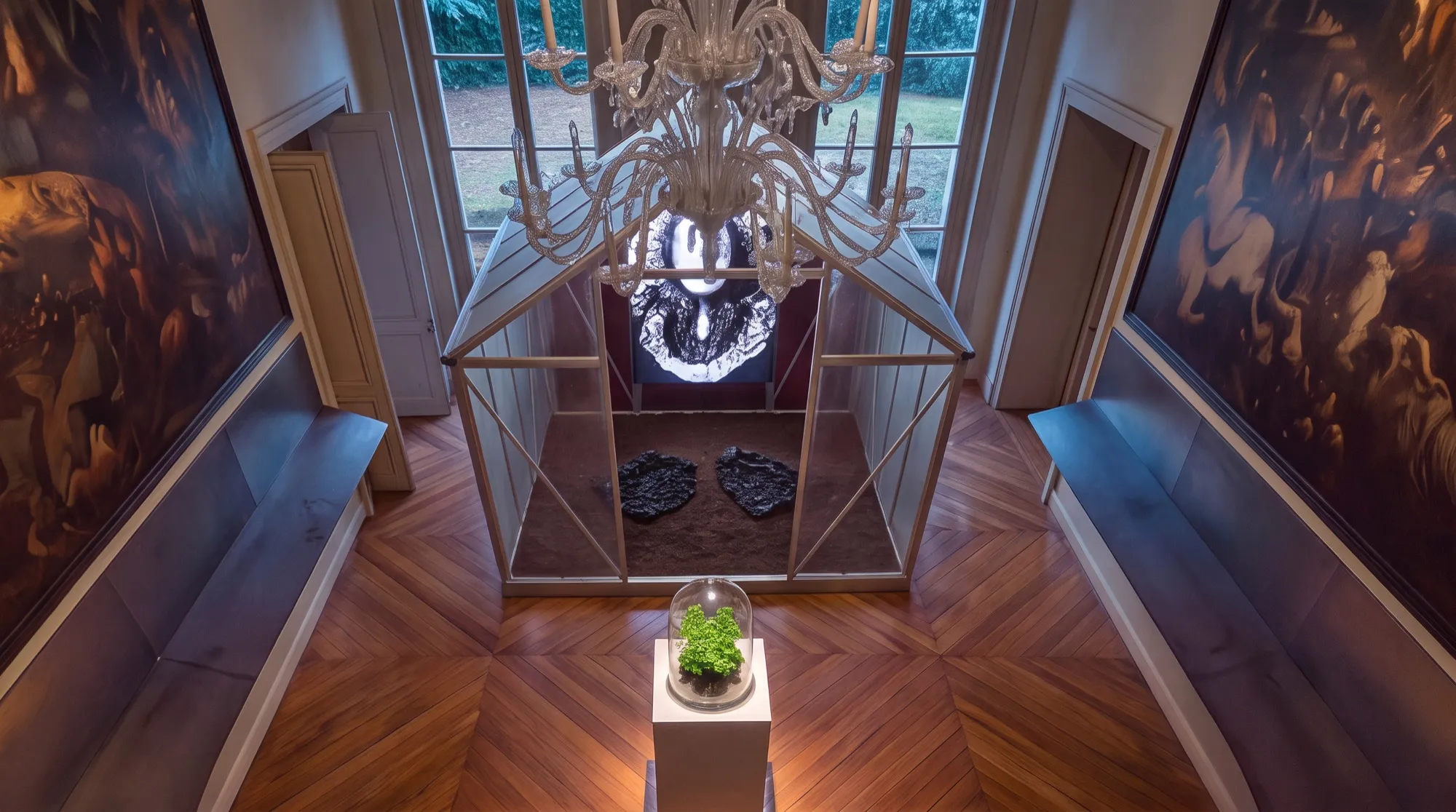
What Superstes measures
Superstes, the installation by Matteo Basilé that the studio developed and produced for the exhibition Magnifica Humanitas at the Italian Cultural Institute in Paris, starts from the same door. Two electrodes on the fronds of a fern, Osmunda regalis, and a thirty-eight minute recording made in the studio in Rome in October 2026. At rest the signal barely moves; at the touch of a hand it leaps and falls back over six to eight seconds. That is an observation, and it should be taken as one. The artist’s text declares the checks still to be done. In my view the first concerns that very peak: telling the fern’s response apart from the effect of contact between a human body and the circuit.
Everything else is declared as construction. From those minutes came a model that imagines a longer stretch of the plant’s life, kept separate from the recorded data. The signals become sound, then rhythm and change in faces photographed by Basilé, with a vocabulary of breath and tears chosen by the artist, who does not give the fern human emotions. The work will be unveiled on 12 November 2026, at the opening of the exhibition curated by Antonio Calbi and Dominique Moulon.
This seems to me the right way to put an electrode inside a work of art: say what comes in through the door and what the person on the other side adds. In 1902 Jagadish Chandra Bose titled one of his books Response in the Living and Non-Living, because he had also studied the electrical response of metals. On its own, an electrode cannot tell the living from the non-living. The person reading the curve does that, along with the way they tell us how they read it.
Sources
- Vocabolario Treccani, «elettrodo» (opens in a new tab)
- Darwin Correspondence Project, lettera di Charles Darwin a J. S. Burdon Sanderson, 13 settembre [1873], DCP-LETT-9055 (opens in a new tab)
- M. Szechyńska-Hebda, M. Lewandowska, S. Karpiński, «Electrical Signaling, Photosynthesis and Systemic Acquired Acclimation», Frontiers in Physiology 8, 2017 (opens in a new tab)
- M. Pollan, «The Intelligent Plant», The New Yorker, 23 dicembre 2013 (opens in a new tab)
- Data Garden, «Introducing PlantWave», 11 gennaio 2021 (opens in a new tab)
- P. Prešeren, «What do plants sound like?», slovenia.si, 16 luglio 2026 (opens in a new tab)
- J. C. Bose, Response in the Living and Non-Living, Longmans, Green and Co., 1902
- ArtistProof, Superstes, scheda del lavoro (opens in a new tab)
Credits
Images: Matteo Basilé, Superstes, installation plan for Magnifica Humanitas, 2026. Development and production of the work: ArtistProof.